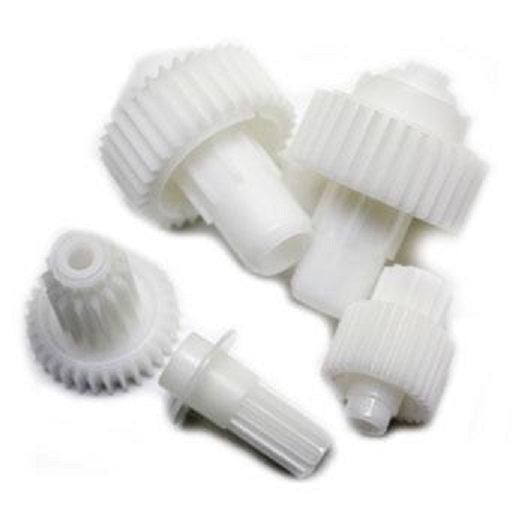
Main applications in our catalog
Gears are found in food processors, automatic coffee machines, blenders, meat grinders, mixers, cleaning appliances, and many other devices. They are key components in motion reduction and transmission systems.
Kenwood
Chef · Major · Prospero · MultiPro
Gears and sprockets for food processors and mixers
De'Longhi
Magnifica · Dinamica · PrimaDonna
Brew group gears and internal transmission
Moulinex / Tefal
Food processors and small appliances
Sprockets and gearbox components
Philips / Saeco
Automatic coffee machines
Brew group transmission gears
Bosch / Siemens
Kitchen and cleaning appliances
Mechanical components for motion transmission
Rowenta
Electric fans and vacuum cleaners
Gears for brushes and rotating systems
Types of gears
Plastic gears
Used in small appliances to reduce noise and costs. They wear over time, especially under heavy loads.
Metal gears
Stronger and more durable, used in applications with heavier loads or where greater precision is required.
Sprockets and gear pairs
They transmit motion between two shafts. Proper meshing is essential to prevent slipping or breakage.
Speed reducers
Gear combinations that reduce speed while increasing torque. Found in food processors and automatic machines.
How to identify the right gear
-
Exact brand and model of the appliance
-
Number of teeth and diameter
-
Material (plastic or metal)
-
Position in the system (transmission, gearbox, motor group)
- Shape and center hole
Most common problems and solutions
⚙️Motor runs but does not transmit motion → broken gear
🔊Abnormal noise → worn or misaligned teeth
💥Broken teeth → replacement required
↔️Excessive play → worn component
📏Incompatible spare part → incorrect dimensions or tooth count
⚠️System jam → deformed gear
FAQ — Frequently Asked Questions
Are gears universal?
No. They are specific to the model and function. Even small differences make the spare part unusable.
How do I identify a worn gear?
Typical signs include worn teeth, cracks, excessive play, or abnormal noise during operation.
Plastic or metal is better?
It depends on the original design. It is always recommended to use the same material specified by the manufacturer.
Can I replace only one gear?
Yes, if the rest of the system is intact. However, in some cases, it is recommended to replace multiple meshed components.
Do I need to completely disassemble the appliance?
Often yes, because the gears are located inside the motor group or gearbox.
Is a photo enough to identify the spare part?
Yes, especially if accompanied by the appliance model and approximate measurements.